Building with AI / November 4, 2026
9x the Average Software Developer in My First Year Full-Time
6,002 GitHub contributions. One solo developer. What a year of building with AI taught me about shipping software for real businesses.
The CodexDeus edition of my original Substack essay ↗.
The headline compares contribution volume with a published commit benchmark. It does not measure a 9x difference in productivity or code quality.
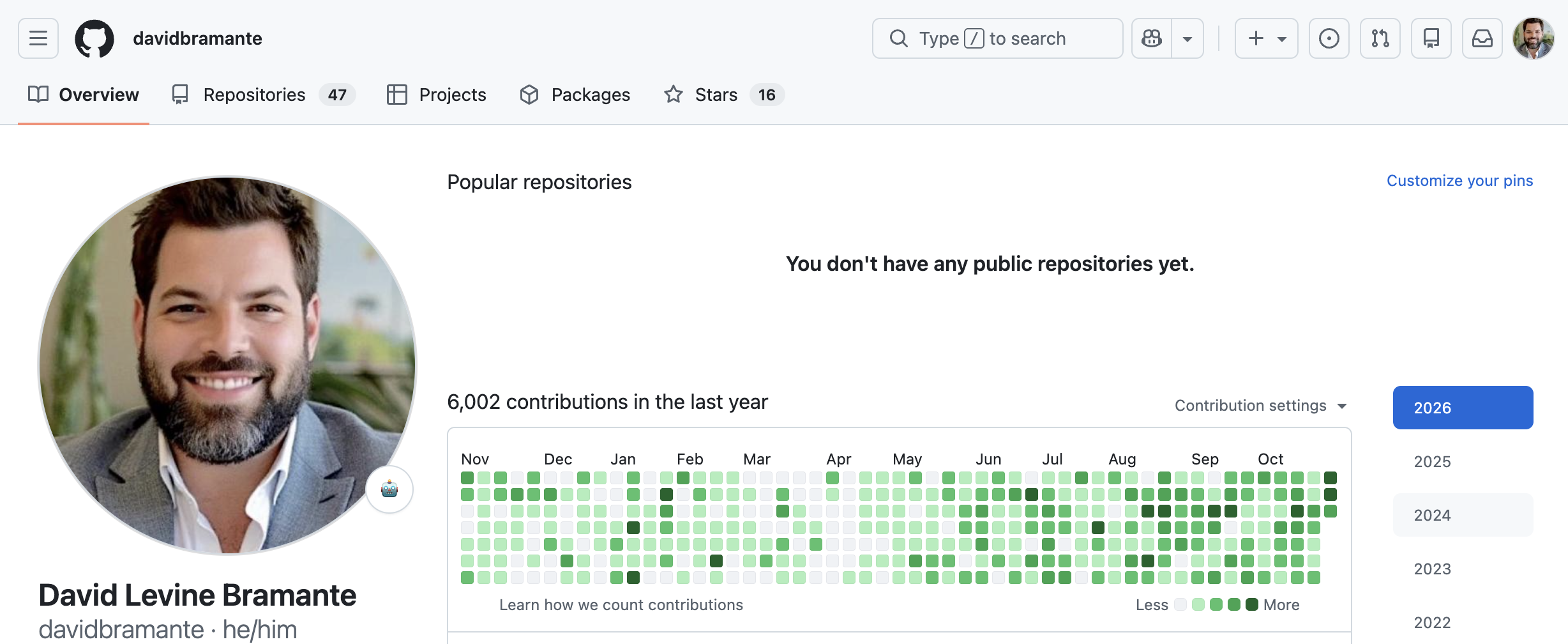
In my first full-time year of software development, I made 6,002 contributions on GitHub, roughly 16 a day, weekends included. I did it as a solo developer, with no team, no agency and no junior devs. Just me and the AI coding agents I direct and review every day.
I’ve been writing code since 2013, but November 2025 through October 2026 was my first year doing it full-time. I wanted to know what that activity actually means compared to other developers. The screenshot above captures the rolling-year total just after that period. My repositories are private because the code belongs to my clients and my own ventures, so the graph gives a public view of activity without exposing their code. I’ve had back-to-back client work since December.
The one light patch on the graph is April, when my family decided to move from LA to Austin and I spent the month flying and driving back and forth. We moved May 1st. I was settled by mid-May, and from there the graph turns dark green and stays that way.
How 6,002 contributions compares
GitClear’s 2024 study examined 878,592 developer-years. Its narrower “career developer” cohort, covering 599,872 developer-years with 241 to 10,000 annual commits, had a median of 673 commits. Dividing my 6,002 contributions by that benchmark gives about 8.9, or roughly 9x.
Contributions and commits are different measures. GitHub contributions include qualifying commits, pull requests, reviews and issues. This is a rough numerical comparison, not evidence that I produce nine times the value of another developer.
I also looked at the August 24, 2026 committers.top US snapshot. A total of 6,002 would numerically sit around position 32 in that particular table. I’m not ranked there: it filters accounts by followers, and its public activity and reporting window differ from mine. That comparison does not establish a national ranking.
Volume is not the same thing as quality. What my graph shows is sustained activity. The more useful evidence for a business is the software I’ve built, how it works, and whether it solves the problem it was built for.
What a year like this taught me
Mastery comes from reps. Thousands of contributions represent a lot of small decisions, mistakes and fixes, and that’s where judgment comes from. I never had one heroic week. I just kept showing up, often late at night after the house goes quiet, and it added up faster than I expected.
Being early has compounded too. I was using Midjourney years ago and started using Claude Code early in 2025. Every month with these tools has taught me where they’re strong and where they fall apart. That experience takes time to build.
AI has changed the job. Agents write a lot of the first draft, which means more review, because every change still has to be read, tested, and kept or thrown out by someone who knows what good looks like.
A version that looks finished in a demo can still be a long way from software you can run a business on.
In my experience, AI can get a product what feels like 70% of the way there very quickly. That’s an illustration, not a measured industry benchmark. The remaining work is logins, payments, permissions, mobile layouts, deployment and the strange edge cases real customers find on day one. That is where much of my year went.
Why this matters if you need software
A focused product can be built within two months when the scope is clear and the tools are used well. The speed comes from a practiced workflow: define the product, build it, review every change, and verify the parts people will depend on.
Many businesses pay for several SaaS subscriptions that each cover part of what they need. One custom tool built around how they actually work can be a better long-term fit, depending on the scope, integration needs and running costs.
When you work with me, the person you talk to is the person writing and reviewing the code. You can ask about a decision and get an answer from the person who made it.
Work with CodexDeus
“I wish we had a system for this.”
That’s a good place to start. I build customer portals, dashboards, marketplaces, custom CRMs and workflow tools for real businesses.
One complete online software product. $20,000 fixed. Delivered within two months. We agree on one focused scope before kickoff. New ideas outside that scope wait for a later engagement.
Discuss your project Or email David directly