Field notes / October 6, 2026
I beat 200+ AI builders at an NVIDIA hackathon.
Originally published on Technically David on Substack ↗. Read the full article here.
Saturday, 2 PM
Twenty-one hours before code and presentations were due, I had nothing. No product. No website. No demo. Just a decision I’d been putting off since Friday night. Friday had been eight hours of brainstorming with strangers. Directions. Constraints. Agent ideas. Better agent ideas. A pile of concepts, zero lines of code, and a room full of smart people talking in circles. I sat there restraining myself. At 44, it felt like every school group project I ever had… I had the idea, and I knew I’d end up doing the work anyway. So at 2 PM on Saturday, I just scrapped everything that was discussed the day before and went with the idea I’d been carrying around since earlier in the year. I’d been helping my wife Kayla and my buddy Jared with their TikTok strategy, and I kept noticing the same gap. Every tool tells you what’s trending. None of them tell you what works for you. So my idea was a TikTok strategist that learns from a creator’s real posting history. I called it TickyTalky. At 3 PM, I started building. Twenty hours to ship four things: the product, the website, the demo, and the presentation.
NVIDIA at a hackathon in Austin?
NVIDIA is the roughly $5 trillion company whose chips power ChatGPT, Claude, and most of the AI you’ve ever touched. They don’t put their name on toy projects. When they co-signed the AITX Community x NVIDIA Claw Agent Hackathon, more than 200 builders showed up, and the room was full of serious people. The brief was not “build something with AI.” It was harder: build a commercial product that gets smarter on its own. Not a chatbot. Something that learns from its own mistakes, like the self-improving agents I wrote about in which AI agents I’m really using.
The trick is not letting it cheat
Here’s the problem with “AI that learns from your past posts.” Any system looks brilliant if it can see the answers. Show a model your whole history at once and it will happily “predict” that your viral video was going to go viral. If you’ve ever pulled comps, you already understand this. An appraiser who could see next year’s sale prices would look like a genius every time. The real skill is pricing the house using only what you knew on the day. So TickyTalky plays it honest. Three AI agents run in a loop:
The Student dreams up ideas and bets on what will hit and what will flop.
The Dealer reveals the creator’s real posts one at a time, in order. No peeking ahead.
The Grader checks every bet against what actually happened.
Every miss becomes a written lesson in a Playbook, and the Student reads that Playbook before its next bet. Video after video, it gets sharper. By the end, it knows your audience better than you do, and it hands you a seven-day plan of exactly what to film next. Here’s what makes it work as a business: nothing gets retrained. Retraining an AI model is slow and expensive, and you’d have to do it for every single creator. TickyTalky keeps a notebook instead. It learns the way a sharp new hire learns: write down what went wrong, and don’t do it again. Faster, cheaper, and personal to every creator who uses it. For the technical crowd: DeepSeek-V4-Flash served from a single NVIDIA DGX Spark, NVIDIA’s desktop AI supercomputer, through a custom-patched build of vLLM, with a NemoClaw/OpenShell recursive harness writing the lessons into the Playbook automatically.
Grading my own TikToks
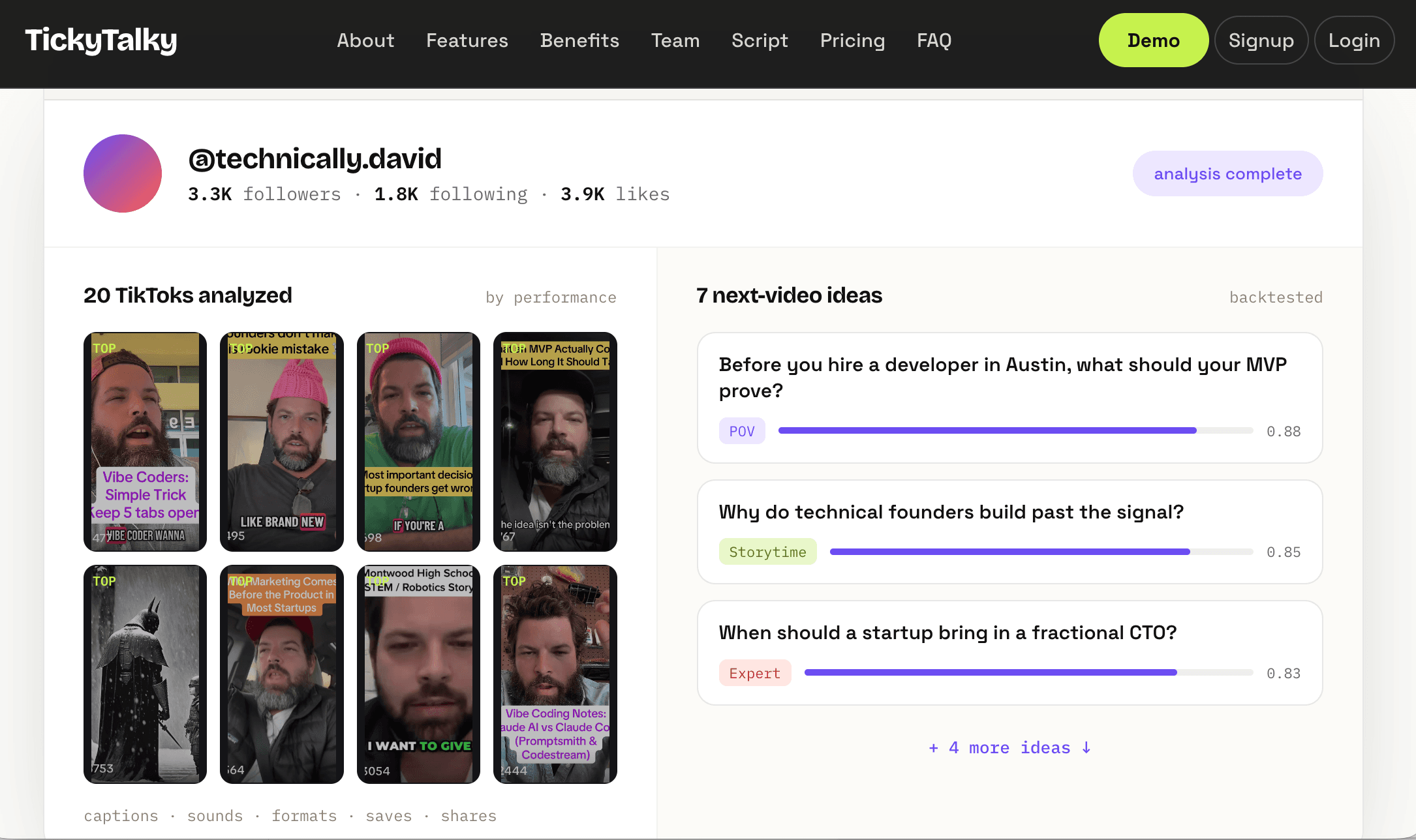
For the demo, I pointed TickyTalky at my own account, @technically.david. Green and red verdicts across every video I’d ever posted: the ones I was proud of, the ones I’d rather forget. Some stung. Most of them were right. Then it showed the learning curve, a cold agent next to a warmed-up one, getting better the more of my history it studied. And it finished with a week of recommended videos. Not “post more consistently.” Actual videos to film. At 11 AM Sunday, I walked in with a working product, a live website, a demo, and a deck. First place. Out of more than 200 builders, judged under the name of a $5 trillion chip company.
The 2 PM decision
Here’s the part I keep thinking about. Eight hours of talking produced nothing. One decision produced a winner. Talking feels like progress. It isn’t. As long as everyone’s still brainstorming, nobody can be wrong, which makes it the safest place to hide. Building is the opposite. The moment I said “I’m building mine,” I owned it. If TickyTalky flopped on stage, that was on me. That’s the real cost of making the call, and it’s why most people never make one. After Factory Guardian, I wrote that the dabbler in me had finally died. I was a builder. TickyTalky taught me there’s a step after that. Building is one skill. Betting on your own idea, out loud, before anyone else believes in it, is a different one. Nobody gives you permission for that.
Try it: tickytalky.com
Watch TickyTalky analyze my account: tickytalky.com/demo
The official hackathon recap: AITX Community on YouTube
My first hackathon story: Factory Guardian
David Levine Bramante
CODEXDEUS
david@codexdeus.com
www.codexdeus.com
TikTok: @technically.david
Instagram: @technically.dave
Build with CodexDeus
Have a product in mind?
One complete online software product. $20,000 fixed. Delivered within two months.
Discuss your project