Field notes / June 28, 2026
I built an autonomous AI safety agent overnight… and it tied for first place
Originally published on Technically David on Substack ↗. Read the full article here.
I was in the backyard this Friday night grilling steaks for dinner, six kids running around, the little Weber going, when the Hackathon challenge-brief starts on Discord: build an AI agent for a real factory problem, and you need to be ready to demo it live tomorrow at 5pm.
I looked at who else was participating in the Hackathon and I had the thought: I’m the amateur who wandered into the wrong room. That imposter syndrome lingered during dinner, playing bingo, eating ice cream, and staying up late with my older kids playing Zelda TOTK.
By 11:30pm the house was finally quiet and that’s when I opened my MacBook and started figuring out how to attack the thing…
Wait… what’s a hackathon?
For anyone who doesn’t live in tech: a hackathon is a sprint. You get a tech problem and a brutal deadline, usually a day or a weekend, to build a working product from scratch and demo it to judges. No teams, no months of planning, no permission or special software. Just you, your laptop, and the clock. This one gave us about 24 hours and one rule: build a real, autonomous AI agent for a factory problem.
This was the American Industrial Revolution Hackathon, and the two names behind it are worth knowing. Zapdos Labs is an AI startup building “video agents” for factories, software that plugs into a plant’s existing cameras, reads its safety manuals to configure itself, and watches the live feeds to catch hazards in real time. If that sounds a lot like what I built over the weekend, it should because that means the people judging my safety agent do exactly this for a living.
Antler was the host: a global early-stage venture firm and “startup generator” that backs founders from day zero, sometimes before they even have a co-founder or an idea. They run programs in around 30 cities worldwide and were the single most active venture capital firm on the planet in 2024; their Austin chapter, Antler ATX, hosted us.
Companies run hackathons for one simple reason: it’s the fastest way to find builders. A weekend of watching people ship under pressure tells you more than any résumé, which is exactly why a venture firm like Antler and an AI lab like Zapdos put one on. The thousand-dollar prize is the bait. The real prize, for them, is the people.
The part that took twelve years
Here’s what most people in my life don’t really know: I’ve been coding at night since 2013. But to almost everyone, I’m the real estate guy. I sold nearly $100 million in deals, and the coding stayed filed under “cute little hobby.” Honestly, for most of that decade, even I half-believed it. I dabbled. I shipped little things. Nothing that made anyone, including me, reconsider the label.
Last year I went all in. Every day, building real products for real founders, treating it like the craft it is instead of the side thing I’d kept it as for years. And here’s what nobody warns you about finally taking yourself seriously: the feeling that you’re faking it gets louder, not quieter. Twelve years of being “the dabbler” doesn’t evaporate because you decided to claim the title. I carried that voice into the room. I carried it all the way to the stage.
What I actually built for the Hackathon
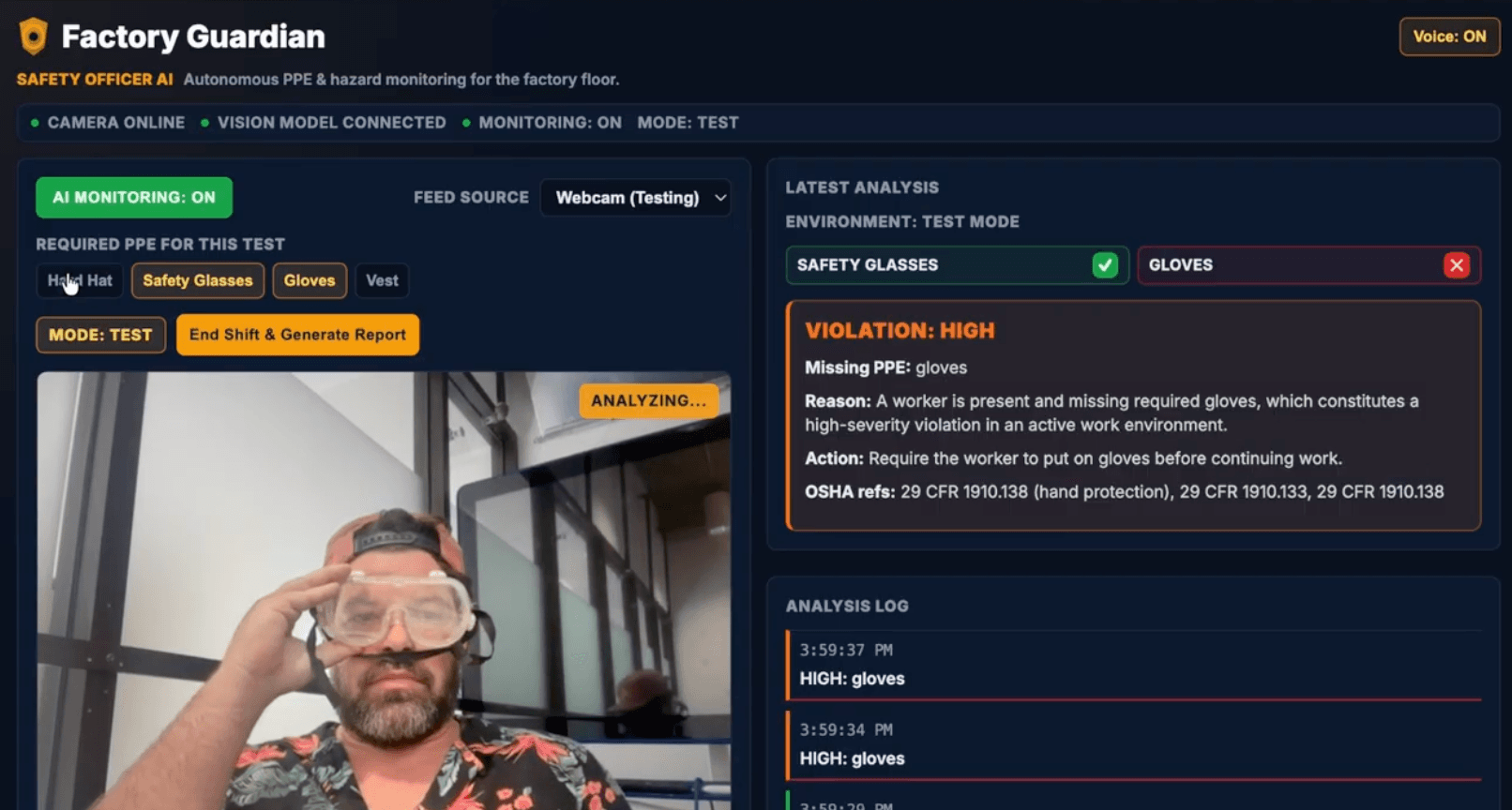
Picture a safety officer or manager who can watch every camera in a factory at the same time, never blinks, and knows every safety rule by heart. The second someone steps onto the floor without a hard hat, it notices, writes it down, and texts the team. That’s the whole thing. I called it Factory Guardian. It knows every factory type and scenario, and every OSHA citation by heart.
It watches the camera, figures out what’s actually dangerous in that exact spot, logs the violation, and fires the alert to the team via Slack… all on its own, no person clicking buttons. That last part is the magic. Most “AI” just talks back to you when you ask it something. This one does things without being asked.
My site’s still up at FactoryGuardian.com, though I’ll be honest: the shared AI engine I built on top of got switched off after the event, so the live detection feature won’t run anymore. The 90-second video I recorded shows the whole thing working: youtu.be/CjafL9r9QgI.
Why a factory would care
Missing safety gear is one of the most-cited violations in the country, and it’s brutally expensive, the average injury claim runs $40,000 to $50,000, and work injuries cost the U.S. around $176 billion a year. Factories already have cameras everywhere. What they don’t have is a person who can watch all of them, every shift, without getting tired. So I built one that can.
Companies already sell this, and it’s not cheap. The category leader charges over $100,000 a year, and a direct competitor just raised a $36 million round to do exactly this. I built the core of that capability overnight for the price of a few subscriptions. Not because I out-engineered teams of hundreds, but because the floor under “what one person can build” has risen that far. The hard part isn’t building it anymore. It’s everything around it.
Then it broke. On stage. In front of the judges.
That morning I recorded a backup video of the demo. I almost didn’t because it felt like overkill when I had a working, deployed product to show live. Thank God I did. When my turn came, the live demo froze: too many teams were hammering the same servers at once, and it picked my moment to die. The screen just sat there, in front of the judges.
So I played the video, talked over it, explained what they were seeing, and the live site came back a minute later, working, for questions. Afterward someone gave me a line I’ll never forget: “Want to lose a sale? Do a live demonstration.” The live thing fails at the worst possible moment, so you always keep the backup ready. That ninety seconds of foresight is the only reason this story has a happy ending.
For anyone still stuck with an old label
If you’ve quietly been becoming something for years while everyone still knows you as the old you like the broker who codes at night, the teacher building an app, the accountant writing a novel, I see you. The label people have for you is just the last data point they bothered to update. You don’t argue with it; you out-build it, until the proof gets too loud to ignore. This weekend, mine got loud.
I walked in convinced I was going to lose, and I never fully shook it. Not while I built, not when the demo died on stage, not even as they read the results. So when “Factory Guardian” came up as a joint first-place winner, the feeling that hit me wasn’t relief. It was pride, real, unfamiliar, almost surprising pride. I’d spent the entire weekend certain I didn’t belong, and I’d won anyway.
Twelve years ago I was a real estate guy who messed around with code at night. I’m still figuring out exactly what I am now, but I think the dabbler is finally gone. The site’s still up at factoryguardian.com, the demo video shows it in action, and I’m walking away a little prouder of myself than I’ve let myself be in a long time.
David Levine Bramante
CODEXDEUS
david@codexdeus.com
www.codexdeus.com
TikTok: https://www.tiktok.com/@technically.david
Instagram: https://www.instagram.com/technically.dave
Build with CodexDeus
Have a product in mind?
One complete online software product. $20,000 fixed. Delivered within two months.
Discuss your project